
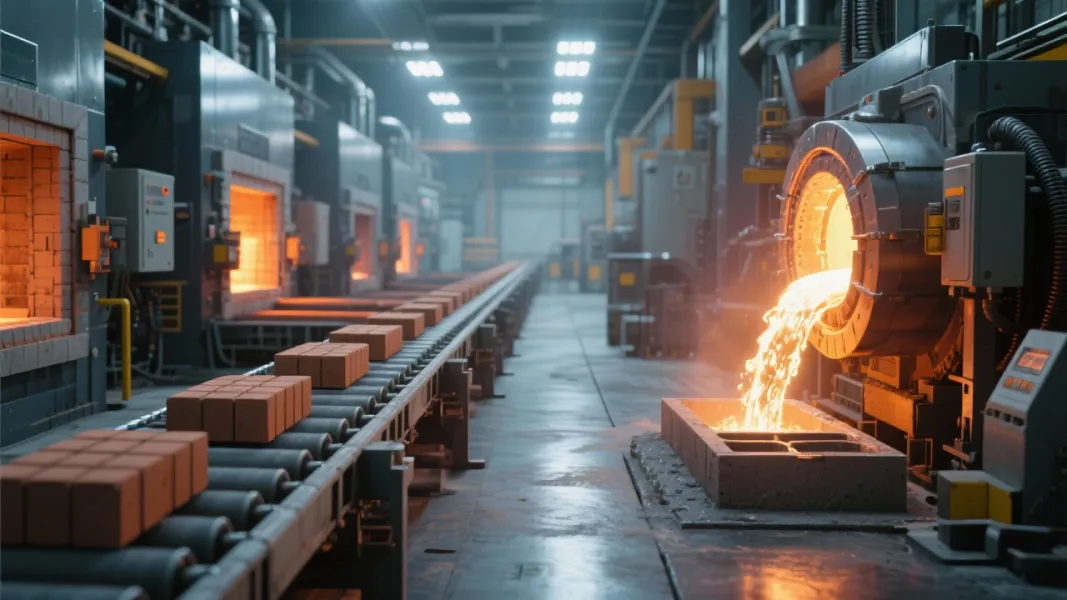
Shaped refractory materials are pre-formed into specific geometric sizes and shapes before being fired at high temperatures. These include products such as high alumina bricks, fireclay bricks, and corundum bricks, which are manufactured with precise dimensions to ensure consistent quality and easy installation.
Their well-defined shapes facilitate rapid assembly and uniform lining, which is essential in industries like steelmaking, cement production, and power generation where structural stability under high temperature is critical.
Unshaped refractory materials, commonly referred to as castables or sprayables, are formed in situ without preforming. They consist of granular refractory aggregates combined with bonding agents that allow molding or casting directly within the furnace or structure.
These materials offer flexibility for complex geometries and repairs, adapting seamlessly to shapes that are difficult for shaped bricks, making them ideal for repair work and specialized furnace linings.
Choosing between shaped and unshaped refractory materials depends on operational requirements, structural design, and maintenance considerations. For example:
Professionals at Shandong Huannai Refractory Materials Co., Ltd. leverage extensive industry experience to advise on optimal materials selection tailored to your specific high-temperature application.
| Feature | Shaped Refractories | Unshaped Refractories |
|---|---|---|
| Form | Pre-formed bricks and shapes | Plastic or cast directly at site |
| Installation | Modular and fast assembly | Casting or spraying required |
| Customization | Limited to standard shapes | Highly adaptable on-site |
| Typical Use | Permanent linings and high-wear areas | Repairs and irregular geometries |
With a commitment to innovation and quality, Shandong Huannai Refractory Materials Co., Ltd. supports clients worldwide by delivering advanced refractory solutions that combine the strengths of both shaped and unshaped materials, securing operational efficiency and durability in demanding industrial environments.

 277
|
277
|
 Shandong Huannai
refractory material failure
high-temperature conditions
material cracking
erosion and spalling
Shandong Huannai
refractory material failure
high-temperature conditions
material cracking
erosion and spalling
 210
|
full lifecycle cost
procurement decision
unit price misconception
downtime loss
Shandong Huannai Refractory Materials
210
|
full lifecycle cost
procurement decision
unit price misconception
downtime loss
Shandong Huannai Refractory Materials
 47
|
Shandong Huannai Refractory Materials
industrial refractory materials
high alumina bricks
castables
high temperature industry
47
|
Shandong Huannai Refractory Materials
industrial refractory materials
high alumina bricks
castables
high temperature industry
 195
|
magnesia carbon bricks alkali slag resistance
high-temperature refractory materials improvement
antioxidant role in magnesia carbon bricks
microstructure analysis of magnesia carbon bricks
refractory corrosion resistance technology
195
|
magnesia carbon bricks alkali slag resistance
high-temperature refractory materials improvement
antioxidant role in magnesia carbon bricks
microstructure analysis of magnesia carbon bricks
refractory corrosion resistance technology
 356
|
Refractory material procurement
Procurement pitfalls
Lifecycle cost
Decision advice
Shandong Huannai
356
|
Refractory material procurement
Procurement pitfalls
Lifecycle cost
Decision advice
Shandong Huannai